

5 Ways to Spot Fake Profiles on Dating Apps Before Matching
I’ve been on dating apps long enough to develop what I’d call a sixth sense for fake profiles. And honestly, it’s not some mystical skill — it’s just pattern recognition built from seeing the same red flags over and over.
TL;DR
- FTC data shows romance scams cost Americans over $1.3 billion in a single year, mostly starting on dating apps
- Reverse image searching every profile photo via Google or TinEye takes 20 seconds and catches stolen model photos
- AI-generated faces in 2026 show tells in ear edges, hair boundaries, and hands with too many fingers
The scary part? most people swipe right before they ever notice the warning signs, and by then they’ve already handed over their attention, sometimes their emotions, and occasionally their money.
Fake profiles are everywhere. Federal Trade Commission data found that romance scams cost Americans over $1.3 billion in 2022 — and the majority of those scams started on dating apps like Tinder, Bumble, and Hinge. That’s not a small problem. That’s a massive, organized industry designed to exploit people looking for genuine connection.
So let me walk you through exactly what I look for before I ever hit that match button.
How Can You Tell If a Dating Profile Photo Is Fake?
The photos are always the first place to look. Real people have messy, inconsistent photo libraries. Their pictures span different years, different hairstyles, different lighting conditions. Fake profiles? They tend to look suspiciously polished.
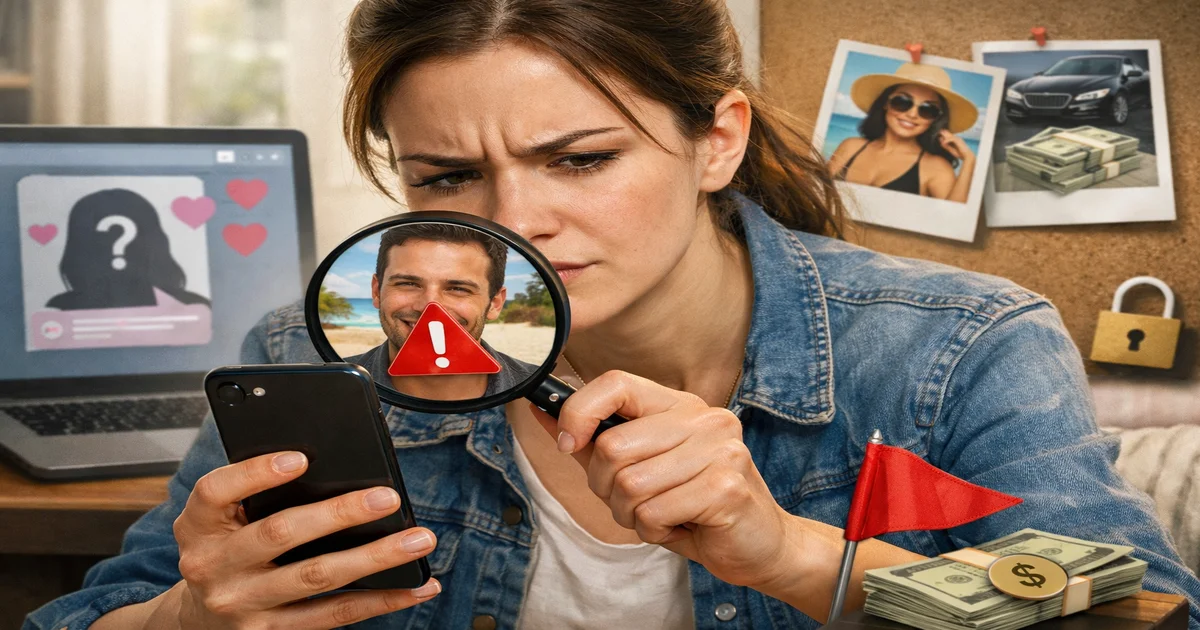
Here’s what I do immediately: I run every profile photo through Google Reverse Image Search or TinEye. It takes about 20 seconds and has saved me from matching with stolen model photos more times than I can count. If the image shows up on a stock photo site or links back to someone else’s Instagram, you’ve got your answer.
Beyond reverse searching, look for these specific visual red flags:
- All photos look professionally shot — no casual selfies, no group shots, no blurry candids
- The person looks like a model in every single image — suspiciously perfect lighting, angles, and editing
- Photos feel inconsistent — like they were pulled from different people’s accounts
- Only one or two photos total — real users usually upload at least four or five
One more thing: AI-generated faces are getting frighteningly good in 2026. Look closely at ears, hair edges, and backgrounds. AI images often have subtle distortions — asymmetrical earrings, hair that blurs into the background, or hands with too many fingers. Train your eye for this.
What Does a Fake Dating App Bio Actually Look Like?
Photos get the attention, but the bio is where fake profiles often slip up. Real people write bios that feel slightly awkward, specific, or even a little boring. Scammers write bios that feel like they were designed to appeal to everyone — because they were.
Watch for bios that are:
- Vague but aspirational — “I love traveling, good food, and deep conversations” with zero specifics
- Oddly formal — grammatically perfect in a way that feels translated or templated
- Emotionally loaded from the start — phrases like “looking for my forever person” or “tired of games” in the very first line
- Inconsistent with the photos — a bio claiming to be a local nurse while photos show someone on a yacht in Monaco
I’ve also noticed that fake profiles often list impressive-sounding careers: military officer, offshore engineer, surgeon working abroad. These aren’t random choices. scammers pick professions that explain why they can’t meet in person — it’s a built-in excuse baked right into the profile.
If the bio feels like it was written to be universally attractive rather than genuinely personal, trust that instinct.
Why Does the Conversation Feel Off With Some Matches?
This is where things get interesting — and where a lot of people get fooled, because the conversation can feel really good at first. Fake profiles operated by real scammers (not bots) are often run by professional teams who do this full-time. They’re good at it.
But there are still tells. Here’s what I’ve noticed:
They escalate emotionally way too fast. Within a few messages, they’re calling you “babe,” talking about how they’ve never felt this connection before, or asking deeply personal questions. Real people take time to warm up.
They deflect specific questions. Ask where they went to high school, what their neighborhood is like, or what they did last weekend. Vague, generic answers — or a pivot back to asking about you — are a bad sign.
They push to move off the app immediately. “I don’t check this app often, can we text?” or “Let’s move to WhatsApp” is a classic move. Dating apps have fraud detection. Personal messaging apps don’t.
Their messages feel slightly off-rhythm. Responses that come at strange hours, feel slightly translated, or use unusual phrasing for a native speaker are worth noting.
The bot-operated profiles are easier to catch — they respond almost instantly, stick to a script, and often send the same opener regardless of what you said. If a conversation feels like you’re talking to a customer service chatbot, you probably are.
Are There Tools That Help Verify If Someone Is Real?
Yes, and you should use them. Most people don’t, which is exactly why scammers keep winning.
Google Reverse Image Search — already mentioned, but worth repeating. Drag the profile photo into images.google.com and see what comes up. Free, fast, effective.
Social Catfish — a paid service specifically built for this. You can search by name, phone number, email, or image. It cross-references public records and social media to verify identity. Worth the few dollars if you’re getting serious with someone you’ve never met.
Spokeo and BeenVerified — similar people-search tools that can confirm whether a name, location, and phone number actually match up. If someone claims to be a 34-year-old teacher in Austin and nothing comes up, that’s a problem.
The app’s own verification features — Tinder has photo verification, Bumble has a selfie verification system, and Hinge has added identity checks. always prioritize matches who have completed the app’s verification process — it’s not foolproof, but it filters out the laziest fakes.
One underrated move: ask them to send a specific selfie. “Can you take a photo holding up two fingers?” A real person does it in two minutes. A scammer using stolen photos can’t.
What Are the Biggest Red Flags Right Before Someone Asks for Money?
This is the endgame for most romance scammers, and the buildup follows a remarkably predictable script. Knowing the pattern is your best defense.
It usually goes like this: intense connection, emotional bonding over days or weeks, then a crisis. The crisis is always something that requires money but prevents an in-person meeting. Common scenarios I’ve seen reported:
- A medical emergency for them or a family member
- A plane ticket to come visit you that they “almost” have the money for
- A business deal that just needs a small bridge loan
- Cryptocurrency investment opportunities where they’ve “already made so much” and want to share it with you
The ask is rarely blunt. It starts with “I’m so embarrassed to even say this” or “I’ve never asked anyone for help before.” They make you feel like you’re the only person they trust. That emotional setup is deliberate.
Here’s my hard rule: if someone you’ve never met in person asks for money in any form, end the conversation immediately. No exceptions. It doesn’t matter how real the connection felt. Real people you meet on dating apps do not ask you for money before you’ve shared a meal together.
Other late-stage red flags to watch for:
- They’ve never been able to video call (always a technical problem)
- Every plan to meet falls through at the last minute
- They know a lot about you but reveal very little about themselves
- They get defensive or guilt-trip you when you ask basic verification questions
Is It Worth Paying for Premium Features to Avoid Fake Profiles?
Honestly, this is a question I get asked a lot. Paid tiers like Tinder Gold or Tinder Plus give you more visibility and features, but they don’t automatically protect you from fake profiles. Neither does Bumble Premium or Hinge’s subscription.
What premium plans do offer is more control — you can see who liked you, filter matches more specifically, and use features like Passport to verify someone’s location. These tools can help you spot inconsistencies faster. But the core work of identifying fakes still falls on you.
The verification badges that come with some premium tiers are more useful than the extra swipes. If you’re going to spend money on a dating app, prioritize platforms that have invested in identity verification over ones that just offer unlimited likes.
My honest take: no subscription replaces your own critical thinking. The five methods I’ve outlined above cost nothing and work better than any algorithm.
Conclusion
Fake profiles aren’t going away — if anything, they’re getting more sophisticated as AI tools improve. But the fundamentals of spotting them haven’t changed much. Bad photos, generic bios, emotional manipulation, and eventually a money ask. That’s the playbook, and now you know it. Run the reverse image search. Read the bio critically. Notice when conversations feel scripted. Use verification tools when things get serious. And the moment anyone asks for money before you’ve met face to face, walk away. Dating apps can absolutely lead to real, meaningful relationships — I’ve seen it happen for people I know.
Frequently Asked Questions
-
How do I reverse image search a dating profile photo on my phone?
On mobile, screenshot the photo, then upload it to images.google.com or use the Google Lens app. Results appear in seconds and show if the image exists elsewhere online. -
Can bots pass as real people on dating apps in 2026?
Yes, AI-powered bots have improved significantly. They can hold basic conversations, but they still struggle with specific personal questions, video calls, and spontaneous photo requests. -
What should I do if I think I matched with a fake profile?
Unmatch and report the profile immediately using the app’s reporting feature. This helps the platform’s moderation team remove the account and protect other users. -
Does Tinder Gold help you avoid fake profiles?
Not directly. Gold gives you features like seeing who liked you and unlimited likes, but fake profile detection still depends on your own judgment and the app’s verification systems. -
How quickly do romance scammers usually ask for money?
It varies, but most scammers wait two to six weeks before making a financial ask. They invest time building emotional trust first, which is what makes the request feel more believable.
⚠️ Disclaimer: This article is educational and does not constitute investment, credit, tax, or legal advice. Rates, products, and regulations change. Consult a certified professional (accountant, financial advisor, lawyer, or your bank) before making decisions based on this content.