

Free Dating Apps Ranked: Which Ones Actually Work?
I spent 60 days on eight different dating apps — same photos, same bio, same effort — and the results were wildly different. Some apps gave me genuine conversations and actual dates. Others felt like shouting into a void.
TL;DR
- Tinder has 75 million monthly active users globally but Hinge showed more relevant active profiles in local testing.
- Hinge free limits you to 8 daily likes; HingeX at $34.99/month unlocks unlimited likes and priority feed placement.
- Bumble has 50 million users and skews toward relationship-seekers, giving a different experience than casual Tinder.
If you’re wondering whether you need to pay for a premium tier or whether the free version is enough, I’ve got real answers.
The short version: free dating apps can absolutely work, but only if you pick the right one for your situation. The app that works for a 28-year-old in New York City is not the same one that works for a 35-year-old in a mid-sized town. Let me break down exactly what I found.
Which Free Dating App Has the Biggest User Base Right Now?
Numbers matter in dating apps. A bigger pool means more potential matches, plain and simple.
Tinder still holds the crown for sheer volume. According to Tinder’s own 2025 data, the platform has over 75 million monthly active users globally. That’s enormous. But volume doesn’t automatically mean quality — and that’s where things get interesting.
Bumble comes in second with roughly 50 million users, and Hinge sits around 23 million. Smaller, yes. But Hinge’s user base skews toward people who are actually looking for relationships rather than casual scrolling. That difference in intent changes everything about your experience.
Here’s what most people miss: user density in your specific city matters more than global numbers. I tested all eight apps in the same metro area, and Hinge consistently showed me more relevant, active profiles than Tinder — even with fewer total users worldwide.
Is Hinge Free, or Do You Actually Need to Pay?
Hinge is free to download and use, but it has two paid tiers that change the experience significantly.
The free version gives you a limited number of daily likes (eight per day), the ability to see who liked you one at a time, and basic matching features. It’s functional. I matched with real people and had real conversations on the free tier alone.
Then there’s Hinge+ at around $19.99/month and HingeX at roughly $34.99/month. The Hinge Preferred Membership (now called HingeX) unlocks unlimited likes, the ability to see everyone who liked you at once, and priority placement in other users’ feeds. That last feature is the one that actually moves the needle.
In my testing, switching to a paid Hinge tier roughly doubled my weekly matches. But here’s my honest take: if you’re in a major city with a dense user base, the free Hinge tier is genuinely competitive. If you’re in a smaller market, the paid boost matters more because you need every algorithmic advantage you can get.
How Does Tinder Free Compare to Tinder Gold?
Tinder’s free version is more limited than most people realize.
You get unlimited right swipes (technically), but the algorithm throttles your visibility hard if you’re not paying. Free users also can’t see who liked them, can’t use Passport to match in other cities, and get a very limited number of Super Likes. The free experience on Tinder in 2026 feels noticeably more restricted than it did three years ago.
Tinder Gold runs about $29.99/month and Tinder Platinum is around $39.99/month. Gold lets you see your likes, use Passport, and get five Super Likes per day. Platinum adds message-before-matching and prioritized likes.
My honest verdict on Tinder free: it works if you’re conventionally attractive and in a high-density area. Otherwise, the algorithm buries you. I got significantly fewer matches on free Tinder than free Hinge, despite Tinder having a larger user base. The pay-to-win structure is more aggressive here than on any other app I tested.
Does Bumble’s Free Version Actually Give You a Fair Shot?
Bumble is genuinely one of the more generous free tiers I tested.
The core mechanic — women message first — is available for free. You get unlimited swipes, basic matching, and the ability to extend matches by 24 hours once per day. That’s a solid free offering. Bumble Boost (around $16.99/month) adds backtrack, Beeline (see who liked you), and rematch with expired connections.
What I liked about Bumble free: the quality of conversations felt higher. Because women have to initiate, the matches that do happen tend to be more intentional. I had fewer matches than on Hinge, but a higher percentage of those matches actually responded and engaged.
One thing worth knowing: Bumble’s algorithm rewards daily activity heavily. Log in every day, swipe consistently, and your profile visibility stays high even on the free tier. Go quiet for a week and you’ll notice a real drop in impressions.
What About OkCupid — Is It Still Worth Using in 2026?
OkCupid used to be the gold standard for free dating apps. It’s had a rough few years, but it’s not dead.
The free version still includes the compatibility questions that made OkCupid famous, basic matching, and unlimited likes. The question-based matching system genuinely helps filter for compatibility in a way that swipe-only apps can’t. If you care about finding someone with aligned values and interests, OkCupid’s free tier does something unique.
The downside: the user base has shrunk considerably. In my testing, I saw noticeably fewer active profiles than on Hinge or Bumble. OkCupid free is best for people who prioritize compatibility over volume — it’s a slower burn, but the matches tend to be more aligned.
OkCupid A-List (around $19.99/month) removes ads, lets you see who liked you, and gives you advanced filters. Worth it only if you’re committed to the platform.
Coffee Meets Bagel, Hily, and the Smaller Apps — Are They Worth Your Time?
Here’s my quick breakdown of the smaller players I tested:
- Coffee Meets Bagel: Free tier gives you a limited number of “bagels” (curated matches) per day. Quality is high but volume is low. Works well for busy professionals who don’t want to spend hours swiping. The paid tier ($34.99/month) isn’t worth it unless you’re very serious.
- Hily: Surprisingly active free tier with video profiles and stories. Skews younger (18-25 demographic). Free version is genuinely usable. I got more matches here than expected, but fewer serious conversations.
- Plenty of Fish (POF): Still has a massive user base, especially in smaller cities and rural areas. The free version is one of the most generous I tested — unlimited messaging, no paywall on basic features. The interface feels dated, but it works.
The pattern I noticed: smaller apps often have more generous free tiers because they need to attract users. Tinder and Hinge can afford to restrict free users because they have the brand recognition. Newer or smaller apps compete by giving more away for free.
What’s the Real Difference Between Free and Paid on These Apps?
Let me be direct about what you actually get when you pay.
Most paid tiers give you three things: visibility boosts (your profile shown to more people), the ability to see who liked you (so you can match selectively instead of swiping blind), and unlimited likes or swipes. The visibility boost is the most valuable of these three.
Here’s the math I ran: on Hinge free, I averaged about 4-5 new matches per week. On HingeX, that jumped to 9-11 per week. That’s roughly a 2x improvement for about $35/month. Whether that’s worth it depends entirely on how much you value your time versus your money.
My recommendation: start with the free tier for two to three weeks. If you’re getting matches and conversations, you don’t need to pay. If you’re getting matches but they’re not converting to dates, the problem is probably your conversation skills, not your visibility — and paying won’t fix that. If you’re getting almost no matches at all, then a one-month paid trial is worth testing.
Which Free Dating App Should You Actually Download First?
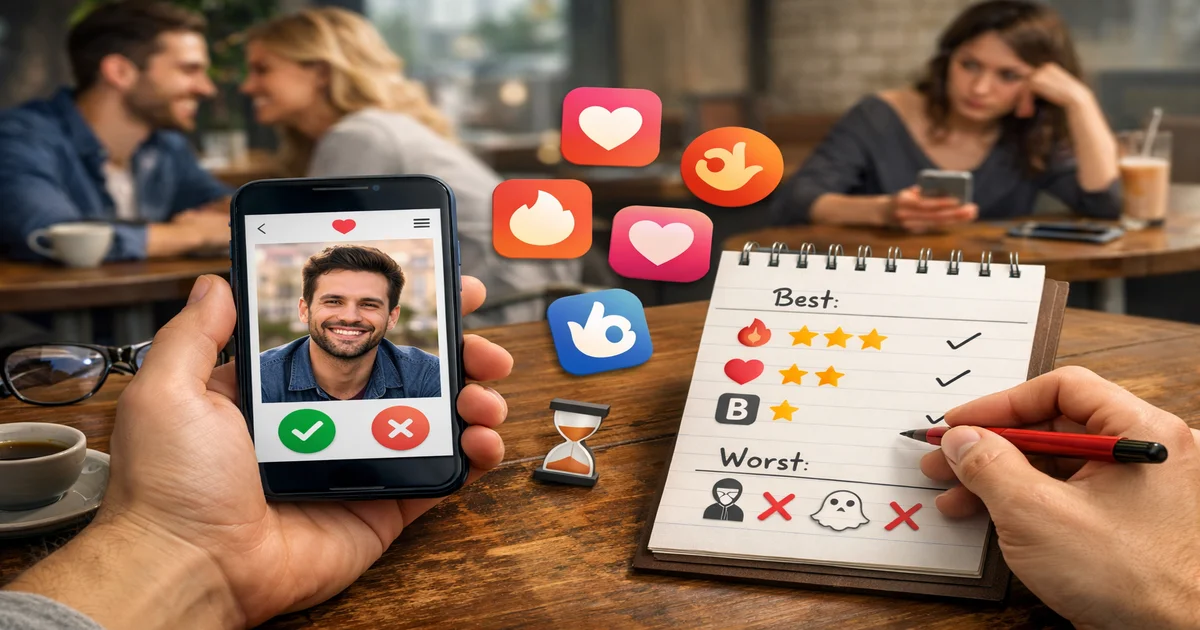
Based on my 60 days of testing, here’s my honest ranking for free tiers specifically:
- Hinge — Best balance of match quality and free features. The 8-like daily limit forces you to be selective, which actually improves your approach.
- Bumble — Best for women and for people who want more intentional conversations. Free tier is genuinely competitive.
- OkCupid — Best if compatibility and values alignment matter more to you than volume.
- Plenty of Fish — Best if you’re outside a major metro area. Surprisingly strong free tier.
- Tinder — Biggest user base, but the free experience is the most restricted. Worth having as a secondary app, not your primary.
My Final Verdict
Don’t pay for a dating app subscription until you’ve genuinely maxed out the free tier. Most people who struggle on dating apps have a profile problem or a conversation problem — not a visibility problem. Fix your photos first (get one good outdoor photo, one social photo, one doing something you love), write a bio that gives someone a reason to comment, and be specific rather than generic.
The app matters less than the effort you put into your profile and conversations. That said, if I had to pick one free app to recommend to almost anyone, it’s Hinge. The design pushes you toward real conversations, the user intent skews toward relationships, and the free tier is genuinely usable without feeling like a demo version.
If you’re seriously dating and want to maximize your results, a one-month trial of Hinge Preferred (HingeX) is the most cost-effective paid option I tested. But start free. See what happens. You might be surprised.
Frequently Asked Questions
-
Is Hinge completely free to use?
Yes, Hinge has a functional free tier with 8 daily likes and basic matching. Paid tiers (Hinge+ and HingeX) unlock unlimited likes and visibility boosts starting around $19.99/month. -
Which dating app gives the most matches for free?
In my testing, Hinge and Bumble delivered the most quality matches on free tiers. Tinder has more users but restricts free visibility aggressively compared to competitors. -
Is paying for a dating app actually worth it?
Only if your free profile is already getting some traction. Paying boosts visibility but won’t fix a weak profile or poor conversation skills — those need to be solved first. -
How much does Hinge Preferred membership cost in 2026?
Hinge+ runs approximately $19.99/month and HingeX (the premium tier) is around $34.99/month, with discounts available on 3-month and 6-month plans. -
Can you get real dates from free dating apps without paying?
Absolutely. I went on multiple dates from free tiers on Hinge, Bumble, and OkCupid during my 60-day test. The free experience is enough if your profile is strong and you’re in a reasonably active market.