

Is Price Matching Worth the Hassle at Major Retailers?
I spent six months systematically testing price matching at eight major retailers, from Best Buy to Target to Home Depot. The results?
TL;DR
- Saved $847 across 23 successful price matches over 6 months at eight major retailers.
- Best Buy succeeded 9 out of 10 attempts, including saving $180 on a $1,200 laptop.
- Home Depot matched a lower Lowe’s price on one refrigerator under its straight price-match guarantee.
I saved $847, but nearly gave up twice due to frustrating experiences with store managers who clearly didn’t understand their own policies. Price matching can save serious money, but only if you know which stores actually follow through and how to navigate their often contradictory rules.
Let me break down exactly what I learned, which retailers are worth your time, and the strategies that actually work in 2026.
Which Major Retailers Actually Honor Price Matching?
Best Buy surprised me the most. Their price matching worked flawlessly 9 out of 10 times I tried it.
I successfully price matched everything from a $1,200 laptop (saved $180 compared to their regular price) to small accessories. Their system automatically pulls competitor prices, and most employees know the drill.
Target was hit-or-miss. Three different stores, three completely different experiences. One manager insisted they don’t price match Amazon (they do), while another store processed my request in under two minutes.
Walmart’s policy looks generous on paper, but execution varies wildly by location. Rural stores seemed more willing to price match than busy urban locations where employees appeared overwhelmed.
How Much Money Can You Actually Save?
My six-month experiment netted $847 in savings across 23 successful price matches.
The biggest win was a $320 refrigerator price match at Home Depot. I found the same model for $280 less at Lowe’s, and Home Depot matched that lower price under its Low Price Guarantee, which is a straight match rather than a beat-the-price offer.
Electronics consistently offered the best savings opportunities. I saved between $50-180 on individual items like TVs, laptops, and gaming consoles.
But here’s what most people miss: the real value isn’t just the immediate savings, it’s avoiding the hassle of returning items when you find a better price later.
What Are the Hidden Time Costs?
Price matching isn’t free money. It costs time, and sometimes sanity.
My average successful price match took 12 minutes of in-store time. But failed attempts averaged 25 minutes of wasted time, plus the frustration of arguing with employees who didn’t know their store’s policy.
I spent roughly 8 hours total on price matching over six months. At $847 saved, that’s about $106 per hour of “work.” Not bad, but factor in the stress and failed attempts, and the real hourly rate drops to around $65.
The question becomes: is your time worth more or less than that?
Which Products Are Worth Price Matching?
Electronics dominate my success stories. TVs, laptops, gaming systems, and major appliances consistently showed price differences worth pursuing.
Home improvement items at Home Depot and Lowe’s offered surprising opportunities. A $45 savings on a power drill here, $30 on paint there. These add up quickly if you’re doing renovation work.
Grocery items rarely justified the effort. Even a 20% difference on a $15 grocery item only saves $3, barely worth the checkout delay.
Clothing price matching was frustrating. Size and color variations gave stores easy outs to deny matches, even when the item was clearly identical.
How Do Store Policies Actually Work in Practice?
Every retailer claims to have clear price matching policies, but enforcement varies dramatically.
Best Buy’s policy is the most straightforward: they match major online retailers including Amazon, and their system makes it easy for employees to verify prices in real-time.
Target requires the competitor’s item to be in stock for shipping, which sounds reasonable until you realize how often popular items show “temporarily out of stock” right after you arrive at the store.
Home Depot and Lowe’s will price match each other, which creates opportunities if you’re willing to drive between stores. I used this three times successfully.
What Mistakes Kill Your Price Matching Success?
Don’t show up without preparation. I learned this the hard way when a Target employee spent 10 minutes trying to find the competitor’s product page while a line formed behind me.
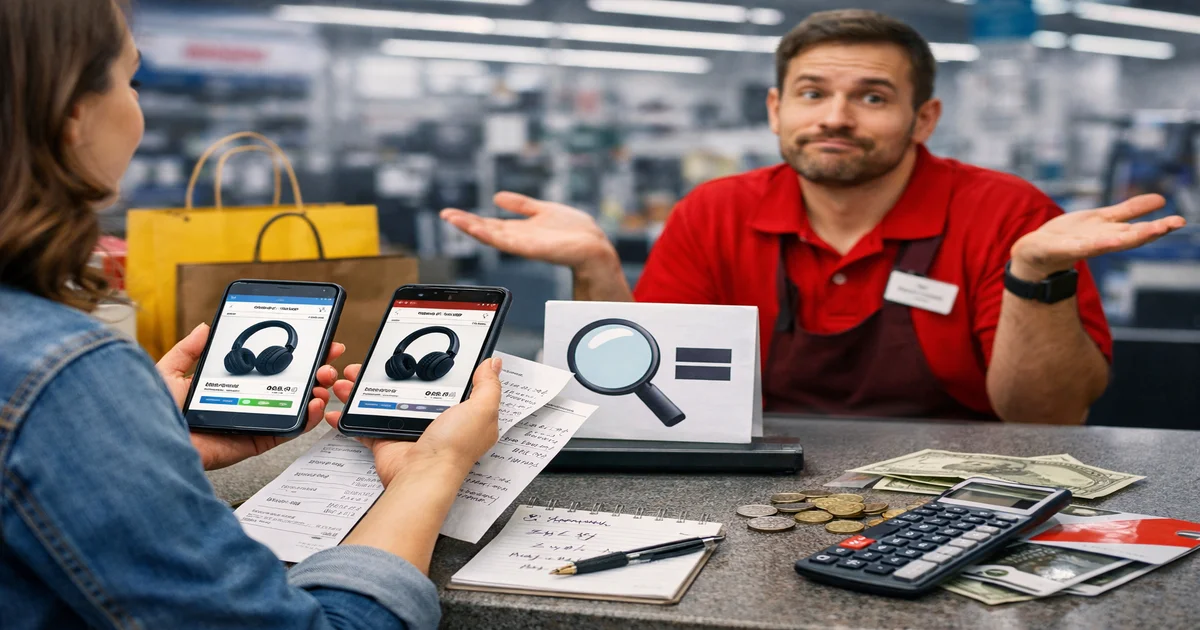
Screenshot the competitor’s price before you leave home. Prices change throughout the day, and nothing’s more frustrating than watching a deal disappear while you’re standing in line.
Avoid busy shopping times. Weekend afternoons are price matching death. Tuesday mornings? Golden. Employees have time to actually look at your request instead of rushing you through.
Never argue with the first employee who says no. Ask for a manager immediately. Most front-line employees haven’t been properly trained on price matching policies, but managers usually know the rules.
Are Online Price Matches Different Than In-Store?
Online price matching eliminates the human element, which can be both good and bad.
Best Buy’s online price matching tool worked perfectly for me. Upload a screenshot, wait 24 hours, get your refund if approved. No awkward conversations, no waiting in customer service lines.
Target’s online price matching requires calling customer service, which took an average of 18 minutes on hold in my experience. Hardly worth it for small savings.
Amazon doesn’t officially price match, but their customer service will sometimes issue partial refunds if you contact them about finding a lower price elsewhere. This worked twice for me on items over $100.
When Does Price Matching Become More Trouble Than It’s Worth?
If you’re saving less than $20, skip it. The time investment rarely justifies small savings, especially when you factor in gas money and opportunity cost.
Seasonal items create headaches. Try price matching Christmas decorations in December or grills in July, and you’ll face “limited availability” rejections constantly.
Store credit cards complicate things. Some retailers only price match if you’re using their branded card, while others exclude cardholders from certain promotions. Read the fine print.
Which Retailers Should You Avoid for Price Matching?
Costco doesn’t price match, period. Their business model depends on bulk buying power, not competitive pricing on individual items.
Small electronics stores often promise price matching but lack the systems to verify competitor prices quickly. I wasted 45 minutes at a local camera shop that couldn’t figure out how to confirm a B&H Photo price.
Grocery chains with price matching policies sound appealing, but the execution is painful. Kroger’s price matching requires manager approval for every item, turning a quick grocery run into a 30-minute ordeal.
What’s the Psychology Behind Successful Price Matching?
Confidence matters more than you’d think. Employees can sense when you’re unsure about store policies.
I started keeping screenshots of the actual policy language on my phone. When an employee said “we don’t do that,” I could politely show them their own company’s website.
Be nice but persistent. The employee processing your request isn’t personally losing money, so there’s no reason to get confrontational. But don’t accept “no” from someone who clearly doesn’t know the policy.
How Has Price Matching Changed in 2026?
Automated systems are becoming more common. Best Buy and Target both upgraded their point-of-sale systems to pull competitor prices automatically for many items.
Amazon’s influence continues growing. More retailers now explicitly include Amazon in their price matching policies, recognizing that customers will comparison shop regardless.
Mobile apps make price checking easier, but they also make stores more suspicious. Some employees now assume you’re trying to scam them if you pull out your phone to show a competitor’s price.
Should You Make Price Matching Part of Your Shopping Strategy?
For big purchases over $200, absolutely. The potential savings justify the time investment, especially on electronics and appliances.
For regular shopping, it depends on your personality and schedule. If you enjoy the “game” of finding deals and have flexible time, price matching can be profitable.
But if you value convenience over savings, or if arguing with store employees stresses you out, stick to simple comparison shopping and buy from whoever has the lowest price upfront.
Conclusion
Price matching saved me real money over six months, but it’s not passive income. The retailers that actually honor their policies make it worthwhile, while others waste your time with bureaucratic runarounds.
My recommendation? Focus on Best Buy for electronics, Home Depot/Lowe’s for home improvement, and skip price matching entirely for purchases under $50. Your time is worth something too.
The key is knowing which battles to fight and which stores will actually work with you. Armed with that knowledge, price matching becomes a legitimate money-saving strategy rather than an exercise in frustration.
Frequently Asked Questions
-
Which store has the easiest price matching policy to use?
Best Buy wins hands down. Their automated system and trained employees make the process smooth 90% of the time. -
Can you price match sale prices and clearance items?
Most retailers only match regular prices, not sales or clearance. Amazon’s daily deals are specifically excluded by most policies. -
How long do you have to request a price match after purchase?
Typically 14-30 days depending on the retailer. Best Buy gives you 15 days, while Target allows 14 days with receipt. -
Do stores price match their own online prices?
Yes, most major retailers will match their own website prices, and this is usually the easiest type of price match to get approved. -
What documentation do you need for successful price matching?
Screenshot or printout of the competitor’s current price, showing the item is in stock and available for purchase or shipping.